Modes in Transitional Millisecond Pulsars: Evidence of Pulsar Wind-Induced Disk Heating from GRMHD and Radiative Transfer

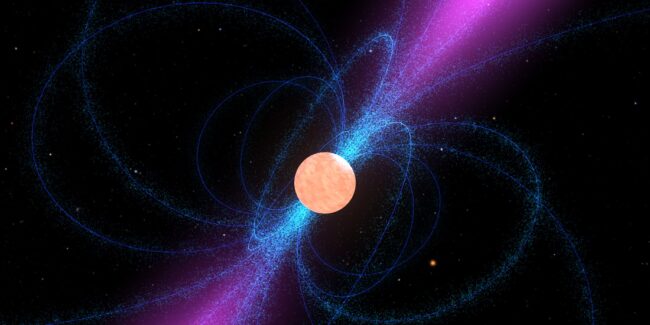
Transitional millisecond pulsars (tMSPs) alternate between radio and X-ray pulsar states, and can represent the missing link between rotation- and accretion-powered neutron stars. Their disk state switches stochastically between the low and high X-ray modes, both of unknown physical origin and less luminous than low-mass X-ray binaries. To reveal the source of the X-ray emission,…

Details

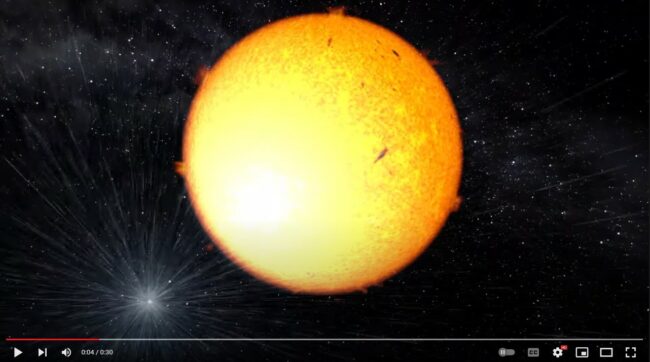
Animation of phenomena (physical effects) and models

Disclaimer ! Made by Maksat Satybaldiev, built entirely with Claude Code. Inspired by: singularity.misterprada.com NASA SVS 11567 NASA SVS 11215 It represents the phenomena (physical effects) and models from the following works: Satybaldiev & Linares 2026 Satybaldiev, Linares, Vecchiotti 2026 Baglio et al. 2023 Turchetta et al. 2023 Papitto et al. 2019 Veledina et al.…

Details

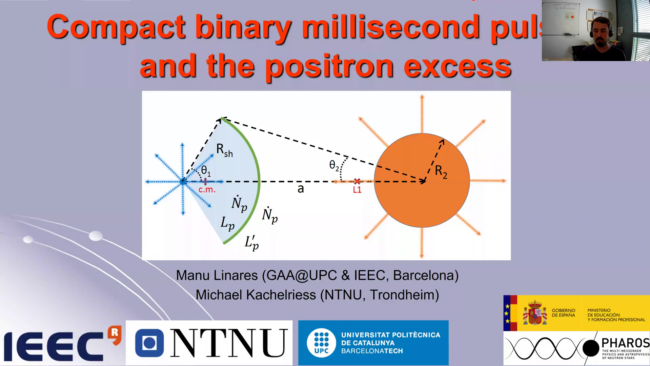
binary millisecond pulsar

New source of lithium production found in the Universe

A team of researchers from the Instituto de Astrofísica de Canarias (IAC), the University of Manchester and the Norwegian University of Science and Technology have detected an anomalously high lithium abundance in the atmosphere of the companion star of a binary millisecond pulsar. The lithium abundance is higher compared to stars with the same effective temperature and high-metallicity stars and so the study provides unambiguous evidence for fresh lithium production.

Details

A massive pulsar irradiates a Solar-type star

A massive pulsar irradiates a Solar-type star

Researchers from the UPC and the IAC discover one of the most massive neutron stars. Using a pioneering method, researchers from the Astronomy and Astrophysics Group of the Universitat Politècnica de Catalunya (UPC) and the Canary Islands Institute of Astrophysics (IAC) have found a neutron star of about 2.3 solar masses—one of the most massive…

Details

A 2.3 Solar-mass neutron star in PSR J2215_5135

A 2.3 Solar-mass neutron star in PSR J2215+5135

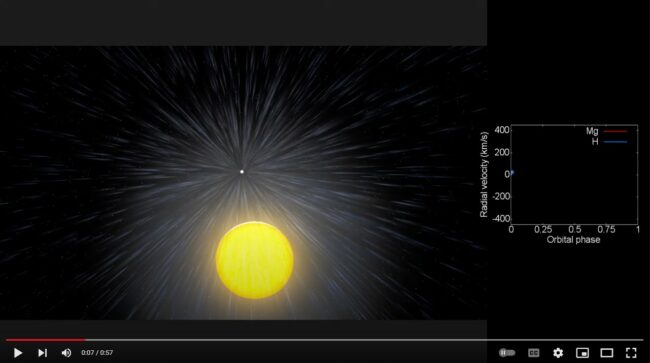
VIDEO: PSR J2215+5135 Orbital period: 4.14 hours Spin period: 2.61 milliseconds Distance from Earth: about 10.000 light-years The inner face of the companion star, strongly irradiated by the pulsar, is heated up to about 8100 degrees Kelvin. As a consequence, hydrogen absorption lines dominate the visible spectrum of the hot side of the star. The…

Details